Overview
- New tech is now available in student housing
- Why new tech is important in student housing
- Recommended technologies to integrate
- Benefits of new tech integration
A New Age
The student housing property management industry is booming with new technologies, and implementing them provides a leg up against competitors. The rise of artificial intelligence, smart home systems, robot assistants, and a myriad of other once unimaginable living improvements has altered home living forever.
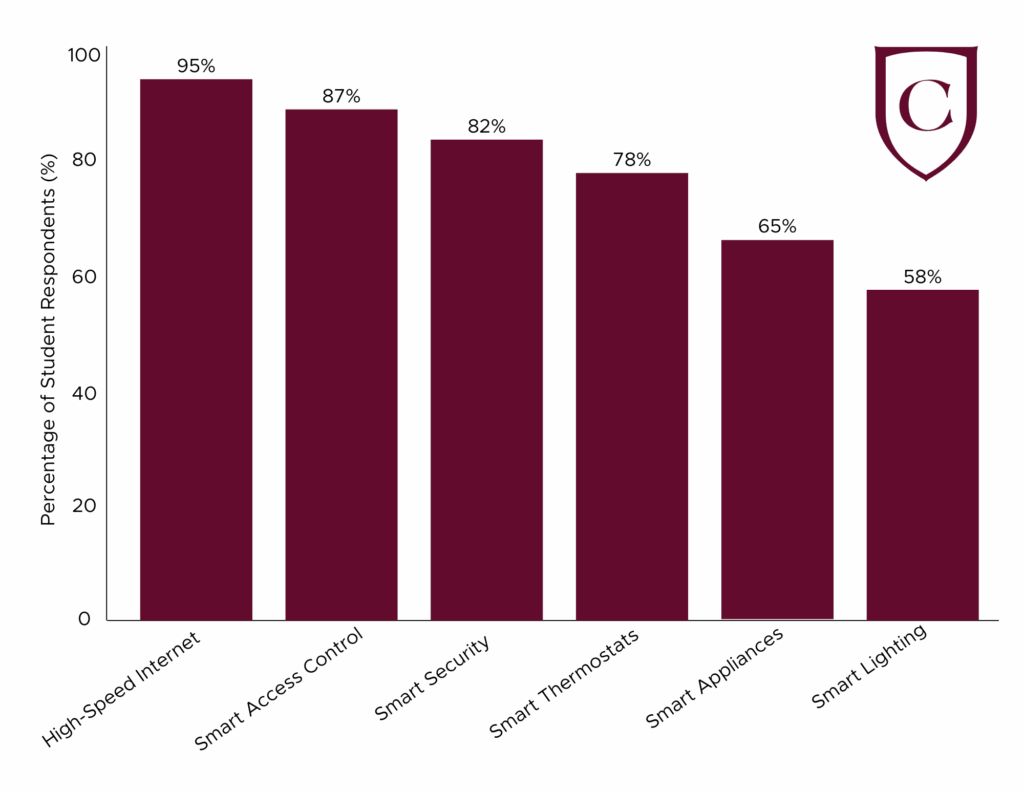
92% of college students take smart technology features into heavy consideration when choosing a place to live for the school year.
The younger generation is more tech-savvy than any other type of resident. College students fit perfectly into this demographic. With so many options and a first-hand knowledge of the difference technology makes in life, college students prefer housing that uses technology to its fullest potential.
Property managers of student housing can better appeal to potential residents by implementing new technologies into their software and living spaces. Before new technologies, student housing was dull, and there was nothing to differentiate one from another. Now, in 2025, properties can find a unique vantage point by making various smart features, artificial intelligence, and software integrations available.
Why in Student Housing?
UniAcco highlights the ways recent technological advancements have changed the way student housing properties operate. They say that years ago, students were subject to manual locks and slow internet.
College students know these struggles all too well. They have arrived at their apartment late at night with nothing to open the front door, roommates having already bolted it shut, being locked out for the night. Poor internet connection slows down homework completion, dragging it out so free time is a foreign luxury to students.
According to UniAcco, smart locks on front doors that do not require a key or a bolt, but a passcode or other high-tech means of access instead are today’s saavy alternative. Integrated security systems solve typical problems, as well as high-speed, reliable Wi-Fi, which has become a standard requirement in student housing.
Recent statistics from a 2023 student housing survey demonstrate that most college students agree. Figure 1 demonstrates results from a survey of college students by ePropertyCare. The data suggests that most college students prefer a wide range of smart technology features in their living space. Specifically, 92% of college students take smart technology features into heavy consideration when choosing a place to live for the school year.
Source: ePropertyCare.com
Technologies to Consider
Smart security systems such as the camera doorbellsor touchscreen door locks with passcodes are safe and effective ways to upgrade apartment security. This rids students of their worries of encountering a stranger at their door or getting locked out.
The smart thermostat connects to an app, which allows tenants to control the temperature of their home wherever they are, whenever. Its smart sense system also turns the air conditioning or heat off when it senses it is necessary, saving energy and money.
While not as vital as security or AC, smart lighting systems upgrade living spaces to a whole new level. The simple clap of a hand turns lights on or off and even changes their color. Such a convenient and flashy amenity is perfect for college parties.
Ensuring residents have Wi-Fi that functions well is a must in student housing. This day in age, upgrading to a plan with high-speed Internet qualifies a property for signing top-notch residents.
Researchers affiliated with University of Sharjah highlight that smart systems can be further improved through the integration of artificial intelligence. AI-powered sensor networks and machine learning can manage HVAC, lighting, and environmental conditions. Integrating AI goes above and beyond, earning the interest of college students even more than other technologies.
Artificial intelligence is a technology through which industries have great opportunity to experiment. Specifically in the student housing industry, AI has the potential to streamline decision and application processes. Professionals from the Information Technologies department at the Politehnica University of Timișoara in Romania recommend integrating artificial intelligence on property websites to match roommates and recommend floorplans according to each applicant’s specific situation.
Benefits of New Tech Integration

Source: ePropertyCare.com
One perhaps less foreseen benefit is decreased maintenance requests in properties that integrate new technologies. This figure reports a 45% reduction. Furthermore, lease-up rates are 15% faster each year, and properties are able to charge 18% more for rent when their technology is up to date.
A company called Verdant (Copeland), which specializes in building automation and energy technology, calls integrating technology into student housing properties “future-proofing.” It reduces energy waste, improves sustainability efforts, and decreases operational costs, preparing properties for long-term success.
Property managers should spend the extra effort to implement new technologies in their student properties – it proves to be worth the time and expenses in the long run.
Taking advantage of these ways to adopt new technology in student housing properties not only streamlines efficiency but creates a higher appeal to prospective residents. In the coming years as more technologies are invented, the student housing market will boom with potential. College students will be more in-the-know than ever. Staying on top of the latest innovations, especially with artificial intelligence, will be the key to fully leased properties, year after year.