

For accredited investors facing significant capital gains taxes from the sale of investment property, the Delaware Statutory Trust (DST) has emerged as a vital tool for wealth preservation. Rather than liquidating assets and triggering a taxable event, sophisticated investors are increasingly turning to institutional-grade solutions. At Crew Enterprises, we specialize in helping investors transition from active landlord responsibilities into passive, tax-advantaged real estate ownership. By leveraging the 1031 exchange provision, our clients can defer federal and state capital gains taxes while upgrading their portfolios into resilient asset classes like student housing and multifamily properties. This guide provides a comprehensive analysis of the DST structure, current market data, and the specific strategic advantages offered by Crew Enterprise DST programs.
What is a Delaware Statutory Trust (DST)?
A Delaware Statutory Trust (DST) is a specialized legal entity that allows multiple investors to hold fractional beneficial interests in institutional-grade commercial real estate. According to IRS Revenue Ruling 2004-86, a beneficial interest in a DST is treated as a direct interest in real estate for tax purposes. This critical ruling qualifies DST investments as “like-kind” replacement property for 1031 exchanges, enabling investors to defer capital gains taxes seamlessly.
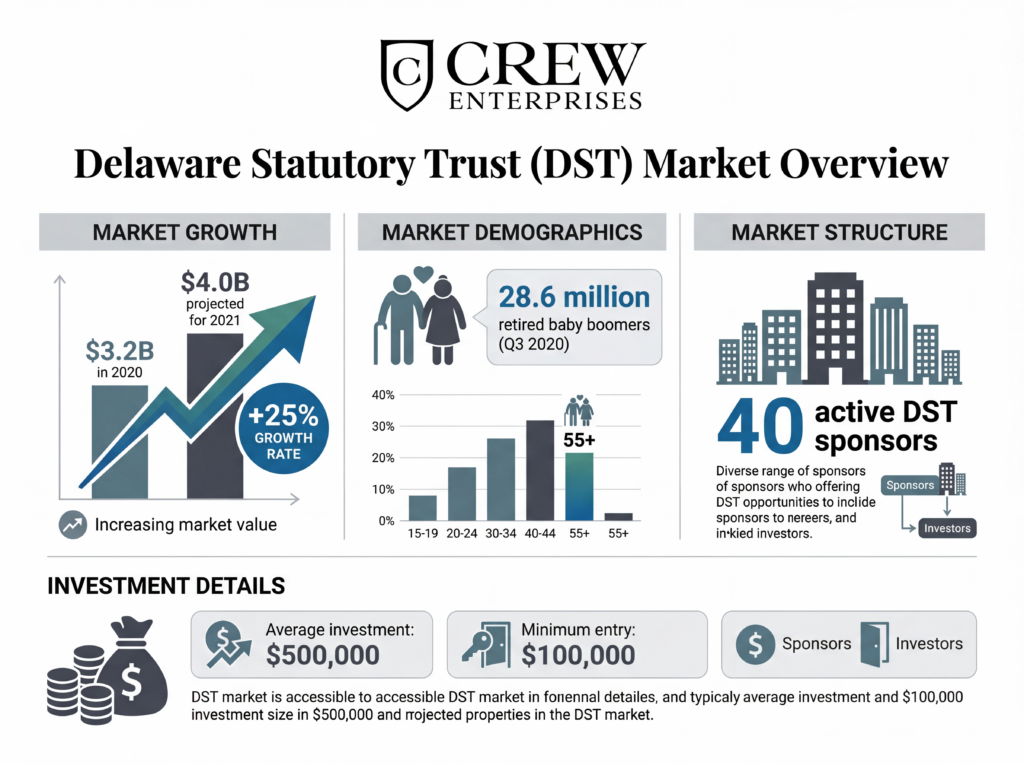
The DST market has experienced explosive growth as baby boomers seek passive income solutions. According to Blue Vault Partners, a leading alternative investment research and due diligence firm that tracks the DST industry, DST sales reached $3.2 billion in 2020 with projections rising to $4.0 billion for 2021, reflecting a year-over-year growth rate of nearly 25%. This surge is driven largely by demographic shifts; Blue Vault Partners reports there were 28.6 million retired baby boomers as of Q3 2020, creating massive demand for passive real estate investments that remove day-to-day management burdens.
Currently, the market is served by approximately 40 sponsors offering 1031 exchange investments via DSTs, as noted by Blue Vault Partners. Unlike public REITs, DSTs are private placements restricted to accredited investors. The structure is designed to be accessible, with the average DST investment hovering around $500,000, though minimums can be as low as $100,000 according to industry research from Blue Vault Partners. This lower barrier to entry allows investors to diversify their exchange proceeds across multiple properties and geographies, reducing concentration risk.
How 1031 Exchanges Work with DSTs
The Section 1031 exchange is a powerful wealth-building tool. According to Blue Vault Partners, these exchanges are utilized in 10-20% of all commercial real estate transactions. In a standard forward exchange, an investor sells a relinquished property and has 45 days to identify a replacement property and 180 days to close on the purchase. A Qualified Intermediary (QI) must hold the funds during this period to prevent “constructive receipt” of the cash, which would trigger a taxable event.
DSTs solve the most common point of failure in 1031 exchanges: the inability to identify and close on a suitable property within the tight IRS deadlines. Because DST properties are already acquired and packaged by the sponsor, investors can often close in a matter of days, eliminating closing risk.
The fiscal impact of these exchanges is substantial. According to research by NAIOP economists Ling and Petrova, published by the Commercial Real Estate Development Association, $9.9 billion in federal revenue loss was attributed to 1031 exchanges in 2019 alone, underscoring the magnitude of tax savings available to investors. More importantly, the data suggests that tax deferral encourages reinvestment into higher-quality assets. The NAIOP research indicates that 62% of exchange investors “trade up” to pricier replacement properties. On average, exchange investors pay $127,500 more (15.4%) for replacement properties compared to their relinquished assets, utilizing their tax savings to acquire superior real estate.
Furthermore, exchange investors tend to be more financially conservative. According to the NAIOP study, 1031 exchange properties typically carry 30% loan-to-value (LTV) ratios, compared to 43% for non-exchange properties. This lower leverage profile aligns well with the DST structure, which typically employs moderate leverage to satisfy debt replacement requirements without overexposing investors to market volatility.
The Benefits of DST Investing
Investing in a Crew Enterprise DST offers a distinct set of advantages for those transitioning from active management to passive ownership.
1. Passive Income Potential
DSTs are designed to generate monthly cash flow, typically targeting annual distributions of 4-6% of Net Asset Value (NAV). This income is passive, meaning investors receive checks or direct deposits without handling tenant calls, repairs, or lease negotiations.
2. Access to Institutional-Grade Assets
Individual investors often struggle to acquire Class A student housing or large multifamily complexes due to high capital requirements. DSTs pool capital from multiple investors, granting access to assets valued at $50 million to $100 million+ that are managed by professional sponsors.
3. Debt Replacement
To fully defer taxes in a 1031 exchange, an investor must replace the value of the debt on their relinquished property. DSTs are typically structured with non-recourse debt in place. Investors assume a pro-rata share of this debt, which satisfies IRS requirements without placing personal assets at risk beyond the investment itself.
4. Diversification
With minimums as low as $100,000, an investor with $1 million in exchange proceeds could theoretically split their capital across multiple DSTs covering different geographies and asset classes. This diversification is difficult to achieve when buying a single replacement property (e.g., a Triple Net lease retail store).
Why Choose Crew Enterprises?
Selecting the right sponsor is as critical as selecting the right property. Crew Enterprises, formerly known as Versity Investments, rebranded in 2024 to better reflect its expanding scope and capabilities. According to a PR Newswire announcement, the firm was founded in April 2022 by industry veterans Blake Wettengel and Tanya Muro, and has quickly established itself as a major player in the alternative investment space.
Despite being a relatively young firm under the Crew banner, the leadership team brings decades of experience. According to company disclosures, Crew Enterprises today manages approximately $2 billion in assets, comprising 35+ properties and over 10,500 beds across 16 states. This scale allows for operational efficiencies and strong vendor relationships that smaller operators cannot match.
Our investment philosophy is grounded in data-driven acquisition. We focus heavily on markets with strong educational demographics and resilient multifamily demand. By concentrating on recession-resistant sectors, we aim to protect investor capital while delivering consistent income.
Student Housing vs. Multifamily: Which is Better?
Crew Enterprises focuses primarily on two asset classes: student housing and multifamily. While both offer residential exposure, the underlying mechanics differ, and recent data suggests student housing may offer superior stability.
Occupancy and Stability
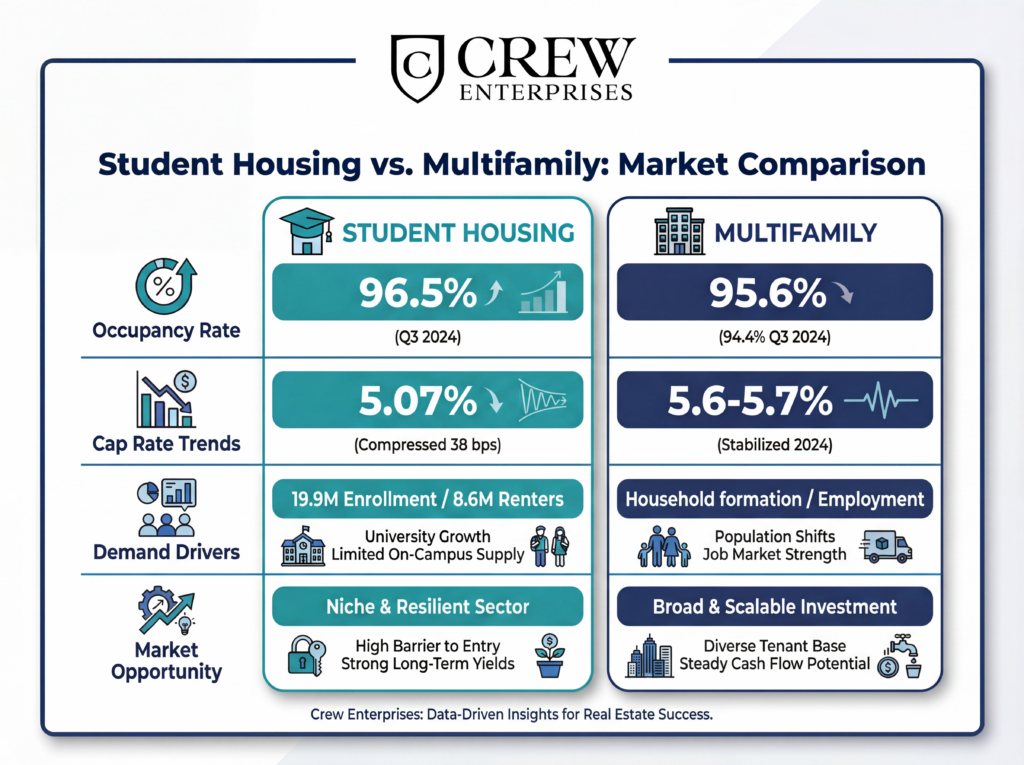
Contrary to the perception of student housing as volatile, the sector has demonstrated remarkable resilience. According to Institutional Real Estate, Inc. (IREI), a prominent institutional investment research publisher, student housing occupancy rates recently reached 96.5%, exceeding traditional multifamily occupancy of 95.6%. This stability is driven by a massive, built-in demand driver. The National Multifamily Housing Council (NMHC), the leading voice for the apartment industry, reports there are 19.9 million students enrolled in U.S. post-secondary institutions, with 8.6 million students renting off-campus housing.
Institutional Capital Flow
Institutional investors have taken notice of this performance. According to CBRE’s 2021 Student Housing Year-End Report, compiled by the world’s largest commercial real estate services firm, investment volume reached $10 billion in 2021, with a record-breaking $5.52 billion in transactions occurring in Q4 2021 alone—four times larger than any prior quarter. This influx of capital has increased liquidity in the sector, a positive sign for investors concerned about exit strategies.
Yield and Pricing Power
The high demand for student housing assets has led to cap rate compression, signaling increased asset values. According to CBRE, cap rates for student housing fell to 5.07% in 2021 from 5.45% in 2020. Despite this compression, student housing still offers a yield premium. The CBRE report shows the cap rate spread over multifamily was 56 basis points overall and 83 basis points for Class A properties in H2 2021. Furthermore, the NMHC notes that with an average student rent of $637/month, the sector maintains strong pricing power.
Multifamily Outlook
While student housing shines, traditional multifamily remains a cornerstone of the DST market. According to Freddie Mac’s 2025 Multifamily Outlook, published by one of the nation’s largest sources of multifamily financing, national multifamily occupancy remained strong at 94.4% in Q3 2024. Looking ahead, Freddie Mac forecasts multifamily rent growth of 2.2% for 2025, slightly below the long-term average, with vacancy expected to rise slightly to 6.2% in 2025 due to new supply. However, transaction volume is expected to rebound to $370-$380 billion in 2025, indicating a healthy, liquid market.
The table below summarizes the key comparisons:
| Metric | Student Housing | Multifamily |
|---|---|---|
| Occupancy Rate | 96.5% | 95.6% (94.4% Q3 2024) |
| Cap Rate Trends | 5.07% (Compressed 38 bps) | 5.6-5.7% (Stabilized 2024) |
| Demand Drivers | 19.9M Enrollment / 8.6M Renters | Household formation / Employment |
| Market Opportunity | Highly fragmented (80% of stock in <50 unit buildings) | Mature, competitive institutional market |
The fragmentation of student housing presents a unique consolidation opportunity for institutional sponsors like Crew Enterprises to add value through professional management. The NMHC study found that 80% of rental stock near major universities is in buildings with fewer than 50 units.
Understanding DST Risks
At Crew Enterprises, we believe in complete transparency. While DSTs offer significant tax and lifestyle benefits, they are not without risks. Investors must understand the limitations imposed by the IRS and the nature of real estate syndication.
- Illiquidity: DST interests are typically held for a period of 5-10 years. There is no public secondary market for these shares. Investors should only commit capital they will not need to access for the duration of the hold period.
- No Control (“Seven Deadly Sins”): To qualify for 1031 treatment, the IRS prohibits DST trustees from taking certain actions, known as the “seven deadly sins.” These include prohibitions on accepting new capital, renegotiating debt, or entering into new leases (except under specific master lease structures). Investors have no voting rights regarding property operations.
- Distribution Risk: Cash flow is not guaranteed. Distributions depend entirely on the performance of the underlying property. Vacancies, unexpected repairs, or economic downturns can impact rental income.
- Concentration Risk: While 1031 exchanges allow for diversification, the strict 45-day identification and 180-day closing windows can sometimes force investors into rushed decisions.
- Sponsor Risk: The performance of the investment is heavily reliant on the sponsor’s expertise. It is vital to evaluate the sponsor’s track record, asset quality, and financial health.
Is a Crew Enterprise DST Right for You?
Determining whether a Crew Enterprise DST fits your portfolio requires a careful assessment of your financial goals and tax situation. These offerings are available exclusively to accredited investors—generally defined as individuals with a net worth exceeding $1 million (excluding primary residence) or annual income exceeding $200,000 ($300,000 for joint filers) for the last two years.
If you are preparing to sell an investment property and wish to defer capital gains taxes while moving away from active management, a DST may be the ideal solution. With investment minimums typically ranging from $100,000 to $500,000, Crew Enterprise DSTs allow you to participate in institutional-quality student housing and multifamily assets that would otherwise be out of reach.
We encourage you to consult with your tax advisor and legal counsel regarding your specific 1031 exchange requirements. For those ready to explore current opportunities, Crew Enterprises offers a robust portfolio of vetted, professionally managed properties designed to preserve and grow your wealth.
Next Steps for Your 1031 Exchange
The clock on a 1031 exchange starts ticking the moment you close the sale of your relinquished property. To ensure a successful exchange, it is crucial to review potential replacement properties well before your 45-day identification period expires. Contact our team today to review our current offerings and secure your financial future through strategic real estate investment.